
Insights & Solutions
Build My Team
Finding good people is only part of the workforce challenge. Print companies are competing for employees who may know little about the industry, developing supervisors while they are already doing the job and trying to retain knowledge that took years to build. There is no single answer—but there are practical ways to widen the talent pool, strengthen the people already on your team and make workforce decisions with greater confidence.
- How do I find people who can succeed in print—even if they do not have print experience?
- How do I know whether our pay and benefits are competitive?
- How do I develop the people I already have?
How do I find people who can succeed in print—even if they do not have print experience?
Begin by separating the skills someone must bring from the skills your company can teach. Print experience may shorten the learning curve, but many successful employees enter the industry with strengths developed somewhere else: mechanical aptitude, attention to detail, problem-solving, comfort with technology, color awareness or the ability to work reliably within a production team.
The opportunity is to recruit for those underlying capabilities while giving candidates a clearer picture of the work, the career possibilities and how they will learn. That requires more than rewriting a job posting. It means making an unfamiliar industry easier to recognize—and easier to enter.
How do I know whether our pay and benefits are competitive?
National salary data can provide a starting point, but compensation decisions become more useful when they reflect the industry, position, company size and labor market in which you are competing. Look beyond the hourly rate or salary. Overtime practices, health coverage, paid time off, retirement benefits, shift differentials and advancement opportunities all influence how employees evaluate an offer—and whether they stay.
The goal is not necessarily to pay the most. It is to understand where your compensation stands, what employees value and where an adjustment could have the greatest effect on recruitment or retention.
How do I develop the people I already have?
Employee development works best when it starts with a business need—not a course catalog. Identify the capability the company needs next, the employee who may be ready to grow and the combination of instruction, experience and coaching that will help that person succeed. Technical expertise, problem-solving and people leadership require different development paths.
Training becomes valuable when employees can apply it to real work, receive feedback and understand what greater responsibility could look like. That is how a company builds capability instead of simply completing courses.
Wage + Benefits Summary - Description of Resource in paragraph form - Download link or widget or something.
Building A Strong Workplace Culture - Description of Resource in paragraph form - Download link or widget or something.
Writing Better Job Descriptions - Description of Resource in paragraph form - Download link or widget or something.
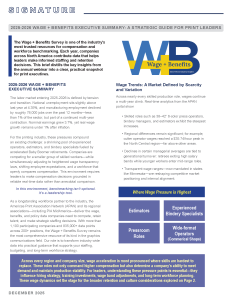
Wage + Benefits Report Executive Summary
See what current wage, benefits, recruiting and retention trends mean for print employers: distilled into a practical executive brief.
Use this resource to:
- Identify roles facing the greatest wage pressure
- Evaluate compensation and benefits priorities
- Strengthen recruiting, retention and workforce planning
Continue with member access:
- Complete Wage + Benefits Reports
- Compensation Planning Tools
- Live Analytics Portal
- Wage + Benefits Webinar

The Job Has Changed. Our Messaging Hasn't
Modern production roles require technology, problem-solving and critical thinking—but many employers are still describing them with language that reflects yesterday’s job.
Use this resource to:
- Recognize where outdated language limits the talent pool
- Reframe production work around its true skills and career potential
- Better connect modern print careers with today’s workforce
Continue with member access:
- Job Bank and Hiring Support
- Job Description Templates
- Modernizing Job Messaging Guide
- PRESS NEXT Certification

Building a Culture of Mentorship in the Printing Industry
Turn experience into a resource your entire company can use. This practical guide and its accompanying templates help employers create mentorship relationships that develop people, transfer knowledge and build future leaders.
Use this resource to:
- Establish clear expectations for mentors and mentees
- Create structure for knowledge and skill transfer
- Support employee growth and leadership development
Continue with member access:
- Designing Career Pathways That Fit the Individual
- MidAmerica U
- Resources for Emerging Leaders
- Supervisor and Leadership Development
Member Resources: Build a Stronger Workforce
PIA MidAmerica members have access to print-specific intelligence, practical learning, workforce pathways and ready-to-use tools that support the entire employee journey—from recruiting the right person to developing the next generation of leaders.
Wage + Benefits Intelligence
Make compensation decisions with industry-specific data.
Compare wages and benefits by position, region, company size and industry segment using PIA’s annual reports and online analytics. Members can evaluate pay, overtime, paid leave, insurance, retirement benefits and other workforce practices with far more relevant context than generalized salary data provides.
Use the intelligence to prepare budgets, review compensation, strengthen recruiting offers and identify the changes most likely to improve retention.
MidAmerica U
Build the capabilities your business needs—when your team needs them.
MidAmerica U gives members on-demand access to technical education, supervisor and leadership development, company-culture guidance, workforce research and practical tools. Learning can support an individual employee, help a new manager succeed or become part of a broader company-development plan.
The platform brings together engaging industry-led lessons on print industry foundations, Thrive sessions, Advisor resources, webinars, guides, templates and downloadable tools in one place.
PRESS NEXT Certification
Create a clearer pathway into print.
PRESS NEXT helps connect education and employment by introducing students to careers in print and supporting the NOCTI Media and Visual Communications certification. Employers gain another way to recognize foundational knowledge, engage emerging talent and build relationships with educators preparing the next generation of the workforce.
Practical Help for the Work Behind the Workforce
Not every people challenge requires a major program. Sometimes you need to fill an opening, modernize a job description, strengthen an employee handbook or give a new supervisor better tools.
Members can also tap into:
- Job Bank listings and promotion of open positions
- Adaptable, modernized job-description templates
- Guidance for writing stronger job postings
- Employee-handbook templates and review support
- Recruiting and employer-brand resources
- Gen Z hiring and retention guidance
- Mentorship guides, agreements and planning tools
- Supervisor, leadership and company-culture development
New resources are added as workforce needs change, giving members a growing source of practical support—not simply a static collection of documents.
Start with the workforce pressure affecting the business.
A critical position that stays open, a new supervisor who needs direction, inconsistent performance or an employment question can reveal where the team is limiting the company’s progress. PIA MidAmerica translates the workforce realities of print into focused training, credible employment guidance and practical talent strategies—equipping the company to strengthen its people and the work they perform..
Gain an Advantage
A stronger business does not have to build every capability, solve every problem or negotiate every agreement alone. The real advantage often comes from knowing what to examine before making a decision, having support when an important relationship is not delivering and gaining access to expertise, intelligence and resources that would be difficult to develop independently.
PIA MidAmerica helps print companies look beyond the immediate transaction—so they can reduce risk, use their resources more effectively and make decisions with greater confidence.
- How do we make a better purchasing decision when price is only part of the cost?
- Who is in our corner when a vendor relationship is not working as expected?
- What can we access through PIA MidAmerica that would be difficult to build or find on our own?
How do we make a better purchasing decision when price is only part of the cost?
The lowest quote does not always produce the lowest cost. Before comparing providers, define what the business actually needs from the relationship. Then look beyond the base price to contract length, automatic increases, minimum commitments, replacement or inventory charges, service expectations, renewal terms and the internal time required to manage the program.
Ask how problems will be resolved, what can change during the agreement and what happens if the service no longer meets your needs. A clear comparison should account for cost, risk, flexibility and performance—not merely the number at the bottom of the proposal. The strongest purchasing decision is the one that continues to make sense after the contract is signed.
Who is in our corner when a vendor relationship is not working as expected?
A contract explains the agreement. It does not guarantee that someone will help when expectations and experience begin to diverge. Start by documenting what was promised, what is happening and how the problem is affecting the business. Review the agreement, invoices and communication history before escalating the issue. A specific record of missed service, unexpected charges or unresolved concerns creates a much stronger basis for action than general dissatisfaction.
It also matters whether someone outside the immediate transaction understands the agreement, knows the people involved and is willing to help restore accountability. When a relationship matters to more than one customer, the conversation can carry greater weight—and the business does not have to navigate it alone.
What can we access through PIA MidAmerica that would be difficult to build or find on our own?
Begin with the work your company repeatedly recreates, the expertise it needs only occasionally and the decisions that would benefit from better industry context. Shared resources can include specialized research, ready-to-use templates, trusted experts, negotiated programs, regulatory guidance and insight from companies that have already faced a similar challenge. Their value is not limited to what they would cost to purchase. They can also save staff time, reduce uncertainty and help the business act sooner.
The greatest advantage comes when those resources are used across the company—not only by the person who manages the membership. Leadership, HR, operations, sales and finance may each find different ways to extend the organization’s capacity.

The Fine Print You Need to Know
A low rate can quickly become an expensive agreement. Learn what to examine before signing—and what to document when unexpected costs or service problems arise.
Use this resource to:
- Identify renewal terms, hidden increases and inventory charges
- Recognize service issues that may support renegotiation or exit
- Compare the full cost and risk of a vendor agreement
Continue with member access:
- Contract Review and Member Support
- Vestis Managed Uniform and Facility Services
- Leverage Programs
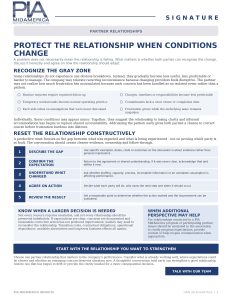
What Strong Partnerships Look Like
Strong business relationships are built through clear expectations, open communication and shared accountability. Explore what helps a company and its partners work well together—and how to address concerns constructively when service, communication or results begin to drift.
Use this resource to:
- Establish clear expectations, responsibilities and measures of success
- Create productive communication before a concern or misunderstanding develops
- Recognize when a relationship is beginning to fall short of its potential
- Address concerns early and determine when additional perspective or support may help
Continue with member access:
- Contract Review and Member Support
- Leverage Program Guidance and Support
- PIA MidAmerica Partner Connections
- Preferred Partner Programs and Member Benefits
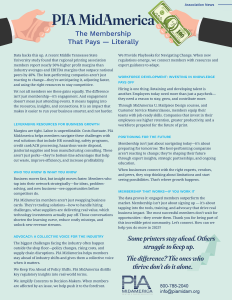
Why Stronger Businesses Don't Go It Alone
Industry research points to stronger performance among association members—but the advantage comes from using the knowledge, relationships and resources membership makes possible.
Use this resource to:
- Understand what association membership can add to your business
- Identify resources that can extend your company’s capacity
- Find more ways to put your PIA MidAmerica membership to work
Continue with member access:
- MidAmerica U
- Member Tools & Resources
- Leverage Programs
- PIA MidAmerica Member Network
Extend Your Company’s Capacity
PIA MidAmerica members can access negotiated programs, specialized expertise and practical tools that would often require considerable time, expense or internal knowledge to secure independently.
The advantage is not simply a lower price. It is having programs shaped around the needs of print companies, trusted support when questions arise and the collective strength of the association behind the relationship.
Reduce Operating Costs
Use established programs to improve essential services without evaluating every provider alone.
- Vestis — Uniforms, towels, mats, mops, first aid and facility services—with preferred pricing, contractual protections and PIA support.
- Clean Earth — Waste-management expertise that can identify better classifications, processes and potential savings.
- CardConnect — Credit-card and ACH payment solutions, including hosted payment pages and no annual fee.
Access Specialized Expertise
Bring in knowledge your company may need—but may not need to maintain internally.
- FSC Group Certification
- Print-specific safety and OSHA support
- Insurance and risk-management guidance
- Retirement and disability programs
- Quality-management and operational resources
Put Practical Tools to Work
Members can also access ready-to-use resources that reduce the need to start from scratch, including:
- Budgeted Hourly Rate Calculator
- Quality Manual Template
- Contract and program guidance
- Industry research and trend reporting
- Employee-handbook review support
- Connections to trusted experts and other print companies
Support Beyond the Program
When a question or problem arises, members are not left to navigate it alone. PIA MidAmerica can help evaluate the situation, connect the right expertise and work with participating partners when service or expectations fall short.
The right advantage depends on the decision in front of you. Continue exploring the programs, intelligence and relationships that can help your company reduce risk, improve performance and act with greater confidence.
Start with the problem you are trying to solve.
An agreement, partner relationship or business program can appear valuable without revealing its full cost, risk or potential. PIA MidAmerica puts collective buying strength, print-industry relationships, contract perspective and member experience behind the decision—giving the company greater clarity, stronger footing and access to advantages it could not create independently.
Grow My Business
Growth is not simply a matter of generating more leads or sending more quotes. For a print company, sustainable growth begins with understanding which work moves successfully through the shop, which customer relationships create mutual value and where the company has a meaningful advantage. It also depends on whether people across the business—from sales and customer service to estimating and production—understand that advantage and can help customers experience it.
PIA MidAmerica connects members to market intelligence, sales development and relationship-building—so they can pursue the right opportunities, communicate their value with confidence and build business that lasts.
- How do we attract more of the customers we are best equipped to serve?
- Why are we losing work we believe we should be winning?
- What makes a customer choose to stay with us—even when another quote is lower?
How do we attract more of the customers we are best equipped to serve?
Begin with the work already moving through your business—not with a new marketing campaign. Analyze which jobs fit your equipment, workflow and expertise particularly well. Look beyond revenue to profitability, production efficiency, repeat potential and the amount of internal friction required to deliver the work. Then consider the customers behind those jobs: What do they value? What problems do they rely on you to solve? Why does the relationship work?
Use those insights to educate the entire team. Salespeople need to recognize the right opportunities, but estimators, CSRs and production employees also need to understand the company’s strengths and how their work contributes to the customer’s success.
Today’s print buyer may not arrive asking for a specific process or product. They may be solving a marketing, operational, fulfillment or customer-communication problem. Consultative sales, relationship-building and a distinctive point of view help the right buyer recognize that your company understands more than how to produce the job.
The goal is not to attract everyone who buys print. It is to become the clear choice for the customers and work you are built to serve.
Why are we losing work we believe we should be winning?
A lost opportunity does not always mean the price was too high. The buyer may not have understood the difference, the recommendation may not have been connected to the business need or the sales process may not have built enough confidence in the decision.
Review where strong opportunities are stalling. Are sales conversations uncovering what the buyer is trying to accomplish—or moving too quickly toward specifications and price? Does the proposal explain the reasoning behind the recommendation? Does the buyer receive useful context that helps them evaluate the options and make a better decision?
Follow-up matters too. A series of generic “checking in” messages rarely adds value. Meaningful touchpoints might include a relevant example, a question the buyer has not considered, insight about production or materials, or a practical idea connected to the intended outcome. Each interaction is an opportunity to demonstrate expertise and reinforce why your company is the right choice.
When price is the only visible difference, the lower quote has the advantage. Consultative selling makes the value of your judgment, guidance and execution easier to recognize.
What makes a customer choose to stay with us—even when another quote is lower?
Customers stay when the relationship consistently makes their work easier, reduces uncertainty and helps them succeed. That trust is built during ordinary interactions—but it is often proven during the difficult ones. Delays, production problems and changing expectations will happen. Honest conversations, timely communication and the integrity to address an issue directly can strengthen a relationship more than pretending everything is fine.
Customers should know what is happening, what it means for them and what your team is doing next. They should not have to chase information or discover a problem after it has affected their plans.
Strong relationships also require curiosity beyond the current job. Create opportunities to understand what is changing in the customer’s business, where they are experiencing friction and what they may need next. When customers consistently receive insight, transparency and dependable support, your value is established long before a competitor submits a lower quote.

Find the Work You’re Built to Win
Define the customers, work and relationships your company is best equipped to serve—then use that focus to strengthen marketing, prospecting and sales.
Use this resource to:
- Identify patterns among your strongest customers
- Connect customer fit to margin, capabilities and workflow
- Build a right-fit customer profile your entire team can use
- Turn the profile into more relevant messages and outreach
Continue with member access:
- The Changing Print Buyer
- Solution-Based Sales
- Customer Insights and Relationship Building

Pricing, Fear and the Moment Before Commitment
Understand why otherwise strong opportunities stall when pricing feels difficult to defend—and how clarity about value, responsibility and positioning supports more confident sales conversations.
Use this resource to:
- Distinguish cost awareness from cost-based pricing
- Recognize where service, coordination and accountability create value
- Identify what pricing hesitation may reveal about internal alignment
- Help salespeople stand behind the value the company delivers
Continue with member access:
- Budgeted Hourly Rate Calculator
- Turning Objections into Opportunities
- What Confident Follow-Up Looks Like

The Relationship Economy
Explore how consistency, clarity and care turn trust into a competitive advantage—and how internal relationships shape the experience customers ultimately receive.
Use this resource to:
- Understand how internal handoffs affect customer trust
- Identify friction that makes the company harder to work with
- Use technology to strengthen relationships—not replace them
- Build consistency and transparency across the customer experience
Continue with member access:
- How to Master the Bad News Conversation
- Communicate Better with Purposeful Touchpoints
- Using Customer Insights to Build Stronger Client Relationships
Build Growth Across the Business
PIA MidAmerica members can access ongoing sales education, marketing guidance, market intelligence and practical tools designed for the realities of selling print.
These resources can help teams move beyond isolated tactics—connecting what the shop does well with the customers it pursues, the value it communicates and the results it measures.
Strengthen Sales and Marketing Skills
Develop the judgment and habits that help teams create demand, guide better conversations and move opportunities forward.
- Thrive Marketing and Sales Briefs — Short, practical sessions addressing current buyer behavior, prospecting, positioning, follow-up and relationship-building.
- The Print University Selling Strategies — Print-specific learning for commercial printers, direct mail providers, sign shops, packaging converters, in-plants and other industry segments.
- MidAmerica U Sales and Marketing Library — On-demand courses and tools that can support owners, salespeople, CSRs and other customer-facing employees.
Explore the Right Growth Opportunities
Evaluate new markets and services against the company’s capabilities, customer knowledge and operational strengths.
- Vertical-Market Primers — Explore the trends, needs and print opportunities within education, healthcare, financial services, manufacturing, nonprofit and government markets.
- Diversification, Measured — Use industry research to examine the margins, retention and stability associated with expanding beyond traditional print.
- Industry Research and Growth Reports — Compare company performance with broader revenue, customer and market trends.
Make the Value of Print Easier to See
Help customers understand what print can accomplish—not only what it costs to produce.
- Proving Print Works — Learn practical ways to connect print with clicks, leads, sales and other measurable outcomes.
- Science of Print — Use research about attention, memory and engagement to strengthen customer conversations.
- Print Enhancements That Perform — Explain how tactile and visual enhancements can influence attention and campaign response.
Create More Opportunities to Be Discovered
Increase visibility with buyers, creatives and organizations looking for print expertise.
- Print Access — Help prospective customers and creative professionals find PIA MidAmerica member companies.
- GraphEx — Use recognized work to demonstrate capabilities, build credibility and start stronger customer conversations.
- Member and Industry Connections — Learn from companies serving similar markets and connect with expertise that can help evaluate an opportunity.
Put the Resources to Work
The strongest results come when sales, marketing, estimating, customer service and production share a common understanding of the work the company wants to win—and the value it is equipped to deliver.
PIA MidAmerica works with members to identify the training, intelligence or practical resource that best fits the growth decision in front of them.
Sustainable growth depends on more than sales and marketing. Continue exploring the people, processes, technology and intelligence that help your company pursue the right opportunities—and deliver on what it promises.
Start with where growth is getting stuck.
Interest may be present while momentum disappears somewhere between market visibility, the sales conversation, the customer experience and operational delivery. PIA MidAmerica follows that opportunity across the full path to revenue—revealing where value is being lost, which part of the business must respond and what can move growth forward.
Improve Operations
A print operation does not lose performance in only one place. Time, capacity and margin can disappear through incomplete specifications, estimating assumptions, scheduling conflicts, long makereadies, equipment downtime, unclear handoffs, rework, material shortages or jobs that simply do not fit the way the shop is built to produce.
Improvement begins by following the work from the customer request through delivery—and using operational information to understand what is actually happening along the way.
PIA MidAmerica stands with members as they evaluate workflow, equipment performance, quality, costing and everyday operating practices so they can make better use of their people and capacity, reduce preventable loss and build a more reliable operation.
- What is preventing the profit we should already be capable of earning?
- How do I make a good decision when the data is incomplete and the stakes are high?
- What should we be doing now to make the business stronger five years from today?
Where are we losing time, capacity or margin as work moves through the shop?
Follow an actual job—not the process you believe it follows.
Begin with the customer request and trace the information, materials and decisions required to move that job through estimating, scheduling, prepress, production, finishing and delivery. Look for places where work waits, returns to an earlier department, requires clarification or depends on someone stepping in to solve the same problem again.
The most visible bottleneck may not be the real constraint. A press waiting for approved files, a finishing department receiving unpredictable work or a CSR repeatedly tracking down missing specifications can reduce throughput long before a machine appears overloaded.
Examine the financial path as well. Compare estimated hours, materials and outside services with what the job actually required. A job can move through the shop successfully and still consume more capacity or margin than expected.
An operational review should help you determine:
- Where information becomes incomplete or unreliable
- Which handoffs create waiting, rework or confusion
- Where actual performance differs from the estimate
- Which types of work move especially well—or poorly—through the operation
- Whether the schedule reflects real capacity and constraints
The goal is not simply to make every step faster. It is to understand where the operation is absorbing cost, risk or complexity without creating value.
Are we getting the performance we should from our people, equipment and operating information?
The answer cannot be found in equipment speed alone.
A machine may be capable of producing more, but actual output is also affected by makeready, job mix, staffing, maintenance, materials, scheduling and the quality of the information arriving with the job. Adding pressure—or purchasing more capacity—will not solve a constraint caused somewhere else.
Start with a small set of reliable measures. Depending on the operation, that might include:
- Estimated versus actual production time
- Makeready and changeover time
- Planned and unplanned downtime
- Spoilage, rework and reruns
- Jobs completed on time
- Throughput by process or shift
- Capacity consistently lost to waiting or clarification
- Contribution by customer, job type or equipment path
Then put the numbers in context. A decline in output may point to an equipment problem, but it may also reveal inconsistent files, poor job sequencing, a training gap or work being assigned without regard to skill and complexity.
Talk with the people doing the work. Operators, CSRs, estimators and production leaders often know where performance is being lost, even when the current reporting does not make it visible.
Good operating information should help the team make a decision. If a measure cannot lead to a useful question, action or comparison, it may be creating more reporting than insight.
What should we standardize so the work is done correctly and consistently—even on the busiest day?
Print is custom manufacturing. Standardization does not mean treating every job as though it were identical. It means creating dependable ways to handle the decisions, information and checkpoints that should not have to be reinvented each time.
Pay attention to problems that repeatedly generate reminders:
- Specifications are often incomplete at intake
- Estimating assumptions do not consistently reach production
- Quality expectations depend on who is running the job
- Preventive maintenance is postponed until equipment fails
- Customer changes are communicated differently by each person
- Critical knowledge lives with one experienced employee
- Problems are corrected, but the learning is not carried forward
These are signals that the operation may need a clearer system—not another conversation asking people to be more careful.
Choose the lightest tool that makes the work reliable. A short checklist may be enough for job intake, shift startup or final inspection. A template can standardize information. An SOP can clarify a process involving several roles or decisions. An automated control may be appropriate when a critical step can be consistently verified by the system.
Build these tools with the employees who use them. Define what must be consistent, where judgment is still required and what should happen when the job falls outside the standard process. Then test the system under real production pressure.
The best operating system is not the one with the most documentation. It is the one people can use to produce the right result when the schedule is full, conditions change and the usual expert is not standing nearby.
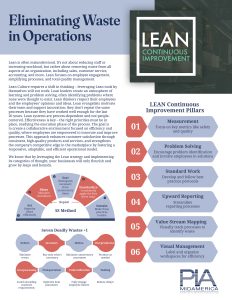
Eliminating Waste in Operations
See how LEAN practices can help reduce wasted time, effort and resources across the business—not only on the production floor.
Use this resource to:
- Recognize the eight forms of operational waste
- Understand the role of measurement, standard work and visual management
- See how employee involvement strengthens problem-solving
- Identify where more consistent processes could improve flow and quality
Continue with member access:
- Sharpen Your Workflow
- Tips for Walking Your Workflow
- Operational Health Check
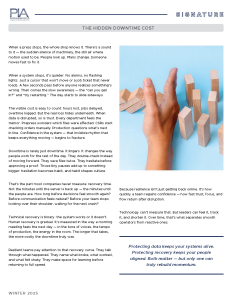
The Hidden Downtime Costs
Understand how workflow disruptions ripple beyond lost production time—affecting deadlines, customer trust, team confidence and the company’s ability to regain momentum.
Use this resource to:
- Recognize the less-visible costs created when work stalls
- Understand how communication and leadership affect recovery
- Consider the human impact of repeated operational disruption
- Help the team return to a stable, dependable workflow
Continue with member access:
- Building Everyday Intelligence
- Operational Agility
- Strategies for Business Resilience

Workflow Automation Success Stories
Explore how print companies are using workflow automation to reduce manual work, improve operating consistency and make better use of their people, equipment and information.
Use this resource to:
- See how printers are automating estimating, inventory, data processing and production workflows
- Understand why successful automation often begins incrementally
- Recognize the connection between consistent processes and effective technology
- Explore how automation can reduce training time, employee strain and everyday fire drills
Continue with member access:
- The Dirty Dozen of Print Automation
- Primer: Key Workflow Processes
- Primer: Software & Functions
Strengthen the Systems Behind the Work
PIA MidAmerica members can access practical tools, print-specific learning and industry expertise to help them understand costs, improve workflow, develop employees and create more consistent operating practices.
These resources support the work that follows diagnosis—when a company is ready to examine the numbers, strengthen a process or give its team a better way to operate.
Understand the Cost of the Work
Connect production decisions with the time, capacity and financial performance required to run a healthy operation.
- Budgeted Hourly Rate Calculator — Calculate the hourly cost of operating equipment or production centers using the company’s actual labor, overhead, capacity and operating assumptions.
- Estimating and Job-Costing Resources — Strengthen the connection between how work is estimated, how it is produced and what it ultimately contributes.
- Industry Performance Information — Use relevant benchmarks and operating data as points of comparison—not substitutes for understanding the company’s own results.
Build More Consistent Processes
Create practical standards for the information, decisions and checkpoints that should not have to be reinvented with every job.
- Quality Management System Template — Establish a framework for documenting responsibilities, processes, quality expectations and corrective action.
- Operational Health Check — Investigate where the company may be losing time, capacity or margin across the full path of a job.
- Continuous Improvement Resources & Consulting Services — Help employees identify friction, examine recurring problems and carry operational learning forward.
Develop Production Knowledge
Give employees a stronger understanding of print processes, terminology, equipment and the decisions that affect work beyond their own department.
- The Print University Series — Print-specific instruction covering production processes, applications and technologies across the industry.
- MidAmerica U Production Library — On-demand learning for operators, CSRs, estimators, supervisors and employees developing broader operational knowledge.
- Production Foundations — Accessible explanations of how print is produced and how decisions in one part of the operation affect the next.
Connect with Operational Expertise
Some challenges require more than another article or checklist. Members can use PIA MidAmerica’s industry relationships to find relevant experience, evaluate options and determine where specialized help may be needed.
- Supplier and Technical Connections — Connect with companies that understand print equipment, software, materials, workflow and production requirements.
- Peer Learning — Learn how other print companies are approaching similar operational challenges, investments and process decisions.
- Resource Navigation and Referrals — Start with the business problem, and PIA MidAmerica can help identify the most relevant tool, training, partner or industry expert.
Put the Resources to Work
Operational improvement is rarely owned by one department. Estimating, customer service, prepress, production, finishing and leadership all influence how reliably and profitably work moves through the company.
PIA MidAmerica helps members move from recognizing operational friction to selecting the tools, information and support needed to address it.
Operational improvement rarely stays confined to the production floor. The way work moves is influenced by employee knowledge, technology decisions, compliance responsibilities and the priorities set by leadership.
Continue exploring the connected business questions that may be contributing to the problem—or affected by the solution.
Start with the friction you can see.
A recurring delay, costly rerun, missed handoff, equipment issue or process dependent on one person is enough to begin. PIA MidAmerica traces that friction across the connected realities of a print business—people, process, technology, cost and capacity—to identify what is constraining performance and determine where the next move belongs.
Lead My Business
Leading a print or packaging company requires decisions that reach across customers, people, equipment, technology, capital and the work moving through the operation. Those decisions rarely arrive one at a time—or with complete information.
A company can be busy without becoming more profitable. It can grow while becoming more dependent on one customer, one leader or one production capability. It can postpone a necessary investment, difficult conversation or leadership transition until circumstances make the decision instead. Strong leadership means understanding what is driving the business now while protecting its ability to perform, adapt and remain valuable in the future.
PIA MidAmerica strengthens executive decision-making with print-specific data, peer perspective and trusted industry relationships—connecting business performance today with the people, systems and capabilities the company will depend on next.
- What is preventing the profit we should already be capable of earning?
- How do I make a good decision when the data is incomplete and the stakes are high?
- What should we be doing now to make the business stronger five years from today?
What is preventing the profit we should already be capable of earning?
Revenue does not automatically create a stronger business. A company may have steady sales, experienced employees and capable equipment—and still produce less profit than its activity suggests it should. The limiting factor may be pricing, customer mix, production performance, outdated costing assumptions or capacity consumed by work that does not contribute enough to the business.
Look beyond whether the shop is busy. Consider:
- Which customers, products and services create meaningful contribution
- Where actual job performance repeatedly differs from the estimate
- Whether pricing reflects current labor, materials, complexity and risk
- Which work consumes disproportionate time, capacity or management attention
- Whether equipment and technology investments are producing the expected return
- Where revenue is growing without producing stronger earnings
The answer is not always to sell more or reduce costs across the board. More volume can intensify an existing problem, and broad cost-cutting can weaken the capabilities the company needs most. The more useful question is whether the company is directing its capacity toward the right work—and being adequately compensated for the value, complexity and resources that work requires.
Profitability becomes clearer when leaders connect financial results with the customers, jobs and operating decisions that produced them. That visibility creates a stronger basis for deciding what the company should pursue, price differently, improve—or stop doing.
How do I make a good decision when the data is incomplete and the stakes are high?
Leaders rarely receive perfect information before they must act. An equipment purchase, pricing change, new market, key hire or change in direction may affect the company for years. Waiting can feel responsible, but delay is also a decision—and it may carry its own financial, operational or competitive consequences.
Good judgment does not require certainty. It requires clarity about:
- The decision that actually needs to be made
- The outcome the company is trying to create
- The assumptions carrying the most risk
- What information is essential—and what would merely be reassuring
- The consequences of acting, waiting or doing nothing
- Whether the decision can be tested, adjusted or reversed
- Whose knowledge should inform the choice
- What the company would need to stop, postpone or change as a result
Not every decision deserves the same process. Some choices are reversible and can be tested through a limited commitment. Others affect capital, people, ownership or customer relationships and require deeper examination. Experience matters, but it can also preserve assumptions formed under different market conditions. Data matters, but numbers without context can create false confidence. Employees, peers and industry specialists may see risks or possibilities that are difficult to recognize from the executive office.
The leader’s responsibility is not to eliminate uncertainty. It is to understand the tradeoffs, make the reasoning visible and move forward with enough conviction that others know what the decision means for their work.
What should we be doing now to make the business stronger five years from today?
A strong business is not simply larger than it was before. It is less vulnerable, more capable and better prepared to perform without depending too heavily on one customer, one person, one market or one piece of equipment.
Consider what the company will need five years from now:
- Leaders prepared to take on greater responsibility
- Critical knowledge that can be transferred rather than held by one person
- Customers and markets that create a healthy balance of opportunity and risk
- Equipment and technology aligned with the work the company intends to pursue
- Financial capacity to invest, recover and respond
- Systems that allow the business to operate consistently as roles change
- A clear path for ownership, leadership or family transition
- A business model that remains valuable as the industry evolves
Succession is part of this work, but future strength begins before an owner is ready to leave. It is built through the decisions that develop other leaders, reduce unnecessary dependencies, preserve institutional knowledge and give the company more options.
Look for areas where today’s stability depends on one person always being available, one customer continuing to buy or one machine continuing to run. These dependencies may be manageable, but they should not remain invisible.
The future will not unfold exactly as planned. The purpose of long-term leadership is not to predict every change. It is to build a company with the capacity, relationships and judgment to respond when change arrives.

The Limits of Your Maintenance Schedule
Explore why preventive maintenance is more than an equipment responsibility—and how postponing necessary work can affect capacity, employees, customer commitments and margin across the business.
Use this resource to:
- Recognize the limits of relying on scheduled maintenance alone
- Understand why operator observations are an important source of business intelligence
- Consider the consequences that follow when equipment unexpectedly goes down
- Examine whether short-term production pressure is creating greater long-term risk
Continue with member access:
- Operational Health Check
- Strategies for Business Resilience
- Continuous Improvement Resources and Consulting Services

The Weight of the Hand-Off
Examine what is really transferred when leadership changes—and why preparing the next person requires more than documenting responsibilities or selecting a successor.
Use this resource to:
- Consider the knowledge, relationships and judgment held by current leaders
- Recognize where the business depends too heavily on one person
- Understand why responsibility must be transferred before authority changes
- Begin thinking about succession as an ongoing leadership responsibility
Continue with member access:
- Succession Planning
- The Middle Layer
- Emerging Leaders Learning Collection
Rebuilding Industry Capability
Explore why the future of print depends on more than filling open positions—and how employers, educators and industry organizations can work together to rebuild the knowledge and capability the industry needs.
Use this resource to:
- Understand the difference between filling jobs and building long-term capability
- Consider how changing technology affects the knowledge employees need
- Recognize the employer’s role in developing people beyond immediate production requirements
- Explore why stronger connections between education and industry matter
Continue with member access:
- MidAmerica U
- PRESS NEXT Workforce Certification
- Building Trust Through Development
Lead with Greater Clarity
PIA MidAmerica equips owners and executives with print-specific financial intelligence, practical leadership resources, industry expertise and relationships with peers who understand the realities of running the business.
Members can draw from print-specific financial intelligence, practical leadership resources, industry expertise and relationships with peers who understand the realities of running the business.
Connect Performance with Business Decisions
Look beyond revenue and activity to understand what is strengthening—or limiting—the company’s financial performance.
- Adjust to Advance: The Profitability Dial — Examine six interconnected areas that influence profitability: price, production, customers, products, people and materials.
- Financial Performance and Industry Data — Compare company results with relevant industry information to identify questions worth examining more closely.
- Financial Executives Council — Engage in recurring conversations about the financial, operational and economic issues affecting print businesses.
Strengthen Executive Judgment
Bring greater discipline and perspective to decisions involving capital, customers, people, markets and the direction of the company.
- Executive Leadership Learning — Explore decision-making, communication, organizational clarity and the responsibilities that accompany leadership.
- Peer Groups and Executive Connections — Exchange experiences with leaders facing similar investments, transitions and business pressures.
- Industry Expertise and Strategic Referrals — Connect with specialists who understand print, packaging and the decisions that shape these businesses.
Develop the Next Layer of Leadership
Create opportunities for other people to build the knowledge, confidence and judgment required to carry greater responsibility.
- The Middle Layer — Examine the critical role managers and supervisors play between executive direction and everyday execution.
- Emerging Leaders Learning Collection — Develop the communication, business understanding and leadership capabilities of employees preparing for broader roles.
- Leadership and Knowledge Transfer Resources — Identify responsibilities, relationships and institutional knowledge that must be intentionally transferred.
Prepare the Business for What Comes Next
Strengthen the company’s ability to perform through leadership changes, market shifts, operational disruption and ownership transition.
- Succession and Transition Planning — Begin addressing ownership, leadership, family dynamics, business value and the future role of current leaders.
- Business Resilience Resources — Examine the dependencies and vulnerabilities that could limit the company’s ability to respond or recover.
- Workforce and Industry Capability Initiatives — Participate in the longer work of developing the people, knowledge and educational connections the industry will require.
Turn Perspective into Direction
Strong leadership does not mean having every answer. It means recognizing the questions that deserve attention, drawing from the right perspectives and making deliberate choices before circumstances make them instead.
PIA MidAmerica connects members’ business questions with relevant data, peer experience, leadership development and specialized industry expertise—turning broad concerns into clearer direction.
Leadership decisions rarely remain confined to the executive office. They shape how work moves, where the company invests, who is prepared to lead and how the business responds to change. Continue exploring the connected questions influencing the company’s performance and future strength.
Bring the Decision into Focus
A strategic choice, unresolved dependency or question that continues to surface often signals that the full picture has not yet come into view. PIA MidAmerica places the decision within the realities of a print business—combining relevant data, peer experience and leadership perspective to reveal the tradeoffs, consequences and dependencies leaders must resolve before making the next move.
Navigate Technology
Technology can increase capacity, reduce friction, strengthen decision-making and create new ways to serve customers. It can also add complexity, accelerate a weak process or introduce risks the business is not prepared to manage. The most valuable technology is not necessarily the newest or most sophisticated. It is the technology that addresses a meaningful business need—and that employees, processes and systems are prepared to use successfully.
That requires leaders to look beyond features and demonstrations. They must understand the problem, evaluate what implementation will demand and consider how the technology will affect people, information, customers and the work.
PIA MidAmerica brings print-specific learning, practical evaluation tools and trusted industry relationships into these decisions—connecting emerging possibilities with the realities of operating the business.
- Where can AI create meaningful value in our business right now?
- How do I know whether a technology investment will solve the problem we actually have?
- How prepared are we to keep the business operating if a cyber incident occurs?
Where can AI create meaningful value in our business right now?
AI is already influencing print—often in ways that do not resemble a chatbot or content-generation tool.
It can appear in equipment monitoring, image inspection, estimating, scheduling, customer communication, sales analysis, administrative work and the movement of information between systems. Some applications are embedded in technology companies already use; others begin with an employee experimenting with a readily available tool.
The opportunity is not to introduce AI everywhere. It is to identify where the technology could create meaningful value.
Look for work that:
- Requires employees to repeatedly find, organize or re-enter information
- Depends on predictable decisions made from recognizable patterns
- Consumes time without requiring the full judgment of the person performing it
- Creates delays between departments, systems or customer touchpoints
- Could benefit from faster analysis, clearer visibility or earlier warning
- Prevents skilled employees from concentrating on higher-value work
A useful application begins with a defined need and a clear understanding of what should improve. Time saved matters, but so do accuracy, consistency, employee capacity, customer experience and the quality of the resulting decision.
AI adoption also introduces responsibility. Customer information, intellectual property, accuracy, bias, contracts and data security must be considered before experimentation becomes an everyday business process.
The goal is not to remove people from the work. It is to determine where technology can extend their capability—while keeping appropriate knowledge, judgment and accountability in human hands.
How do I know whether a technology investment will solve the problem we actually have?
A compelling demonstration can make the solution appear obvious. The harder work happens before the demonstration begins.
A recurring problem may appear technological while its actual cause lies elsewhere. Employees may be working around an unclear process. Information may be incomplete or inconsistent. Systems may not exchange data reliably. A task may lack clear ownership. Adding technology without understanding that underlying condition can make the problem faster, more expensive or more difficult to see.
Before comparing platforms, equipment or features, clarify:
- What is happening now—and what evidence shows where the problem begins
- Whether the constraint is rooted in people, process, information or technology
- What should meaningfully improve if the investment succeeds
- Who will use, manage and maintain the solution
- What must change in the surrounding workflow
- What implementation will require beyond the purchase price
- How success will be measured after launch
- Whether the idea can be tested before the company commits at full scale
Readiness matters as much as capability. A powerful system cannot create clean data, clear processes, employee adoption or executive ownership on its own.
The strongest technology decision connects the tool to the work before the company connects the tool to its systems.
How prepared are we to keep the business operating if a cyber incident occurs?
Cybersecurity is not only an IT responsibility. It is a business-continuity responsibility.
Print and packaging companies depend on connected systems to receive files, manage customer information, schedule production, operate equipment, communicate with employees, ship work and collect payment. When those systems become unavailable—or the integrity of the information cannot be trusted—the disruption can reach every part of the company.
Preparation begins by understanding the business consequences:
- Which operations would stop if critical systems became unavailable
- What customer, employee or financial information the company must protect
- Who has access to important systems and how that access is managed
- Whether employees can recognize and report suspicious activity
- How essential data and configurations could be recovered
- Who would make decisions and communicate during an incident
- Which technology providers, insurers, advisors or authorities would need to be contacted
- How the company would continue serving customers while systems are restored
Technical protections matter, but readiness also depends on employee awareness, disciplined access, tested recovery practices and clear ownership. The defining question is not simply whether the company can prevent every incident. It is whether the business can recognize what is happening, contain the damage and continue operating when prevention is not enough.

Working with AI: Stay Curious. Think Critically
AI can expand what people are capable of doing—but it cannot assume responsibility for the work. Explore how curiosity, critical thinking and human judgment can lead to more useful AI-assisted work while protecting the information, people and businesses involved.
Use this resource to:
- Explore AI without surrendering your own thinking or expertise
- Consider what information is appropriate to share before you begin
- Question responses, add context and recognize what the tool may be missingVerify the result and remain accountable for what moves forward
Continue with member access:
- AI for Printers Learning Collection
- AI Policy and Governance Resources
- Technology Evaluation Resources
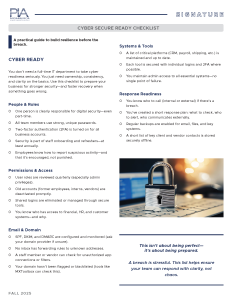
Cyber Secure Ready Checklist
Examine the people, access, systems and response practices that influence the company’s ability to prevent, recognize and respond to a cyber incident.
Use this resource to:
- Identify foundational cybersecurity practices that may require attention
- Consider how employees and access decisions affect business risk
- Recognize gaps in system protection, data recovery and incident response
- Begin a more informed conversation with internal or external technology experts
Continue with member access:
- Cybersecurity Learning and Awareness Resources
- Cybersecurity Insurance Guidance
- Industry Technology Connections
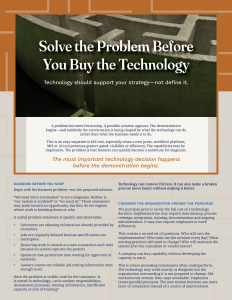
Solve the Problem Before You Buy the Technology
Explore why the most important technology decision happens before the demonstration begins—and how defining the business problem can prevent companies from investing in tools their people, processes or systems are not prepared to use successfully.
Use this resource to:
- Distinguish a technology problem from a people, process or information problem
- Define what should meaningfully improve if the investment works
- Consider the full requirements of implementation—not only the purchase price
- Evaluate whether the company is ready to adopt, manage and sustain the solution
Continue with member access:
- Technology Decision Brief
- Technology Evaluation Resources
- Supplier and Technical Connections
Turn Technology Questions into Better Decisions
Technology decisions do not have to begin with an online search or a sales demonstration. PIA MidAmerica connects members with print-specific learning, experienced peers, trusted suppliers and specialized advisors—bringing greater context to decisions involving equipment, software, AI, cybersecurity and business risk.
Build Knowledge Before Investing
Develop the internal understanding needed to evaluate opportunities, recognize risks and participate confidently in technology decisions.
- AI for Printers Learning Collection — Explore practical applications, responsible-use considerations and the changing role of AI across the business.
- MidAmerica U Technology Resources — Build knowledge through print-specific courses, expert conversations and recorded learning.
- Technology Decision Brief — Define the business problem, desired result, implementation requirements, total cost and measures of success before evaluating solutions.
Connect with Industry Expertise
Reach beyond features and sales claims to understand how a solution will function within the realities of a print or packaging operation.
- Equipment and Software Supplier Relationships — Connect with companies that understand print workflows, production requirements and the systems surrounding the work.
- Industry Technical Specialists — Identify expertise related to integration, automation, data, cybersecurity and other specialized technology needs.
- Member Experience and Peer Perspective — Learn from companies that have evaluated, implemented or moved away from similar technologies.
Protect the Business
Address the human, operational and financial risks that accompany greater dependence on connected systems and digital information.
- Cybersecurity Learning and Awareness Resources — Strengthen employee awareness, access practices, data protection and incident readiness.
- Federated Insurance — Bring insurance and risk-management perspective into questions involving cyber exposure, business interruption and organizational preparedness.
- Policy and Governance Resources — Establish clearer expectations for AI use, customer information, system access and employee responsibility.
Put Industry Leverage to Work
PIA MidAmerica’s relationships across the industry give members more places to turn when the right answer is not yet clear.
Those connections can clarify the available options, identify questions that should be asked and connect members with relevant expertise. The objective is not to recommend a particular product or make the decision for the company. It is to ensure that members do not have to navigate consequential technology decisions alone—or rely solely on the company selling the solution.
Move from Possibility to Practical Direction
Begin with the problem, opportunity or risk the business is trying to address. PIA MidAmerica brings together learning, peer experience, supplier relationships and specialized expertise—giving members a stronger foundation for deciding what to pursue, what to question and what the business must prepare before moving forward.
Technology does not operate separately from the business. Its value depends on the people using it, the operation surrounding it, the decisions guiding it and the industry conditions shaping what comes next.
Continue exploring the connected questions that influence whether technology creates meaningful value.
Find the Right Starting Point
Begin with the problem the business needs to solve—not the technology being considered. PIA MidAmerica connects members with relevant learning, peer experience, supplier relationships and specialized expertise to help clarify the opportunity, evaluate the risks and determine what the business should prepare before moving forward.
Stay Compliant
Compliance protects more than the company from a citation or penalty. It protects employees, preserves the ability to operate and reinforces the trust customers, insurers and business partners place in the organization.
The challenge is that compliance does not stand still. Regulations change. Equipment, materials and responsibilities evolve. Informal practices become routine. A company may believe it is protected because a policy exists—while everyday behavior, incomplete documentation or an unrecognized exposure tells a different story.
Strong compliance begins with understanding what applies, making responsibility clear and bringing required practices into the way work is actually performed. It also requires knowing when the company needs specialized guidance rather than relying on assumptions or outdated information.
PIA MidAmerica connects members with print-specific safety knowledge, regulatory information, training resources and experienced partners who can help identify risk and translate requirements into practical action.
- What are the most important safety risks in our operation—and are we controlling them?
- What changed—and what does our company actually need to do about it?
- What environmental responsibilities apply to our operation—and where are we exposed?
What are the most important safety risks in our operation—and are we controlling them?
Every production environment contains risk. The question is whether the company understands where its most consequential hazards are—and whether the protections established on paper are consistently practiced in the operation.
A written safety program is important, but it cannot account for every shortcut, work-around or change in daily conditions. Equipment moves. Responsibilities shift. Experienced employees develop habits. New employees learn by observing what others actually do, not only what they were told during orientation.
Look closely at:
- Where employees interact with moving equipment, stored energy, chemicals or material-handling systems
- Which tasks depend heavily on individual judgment or informal instruction
- Whether required guards, protective equipment and safe-work practices are consistently used
- How maintenance, cleaning, jams and unexpected production problems are handled
- Whether employees feel responsible and empowered to identify a hazard
- How near misses, injuries and employee concerns are documented and reviewed
- Whether training reflects the equipment and work employees perform today
- Where production pressure may encourage people to bypass established practices
The most visible hazard is not always the greatest risk. Familiarity can make an unsafe condition feel normal, particularly when it has not yet caused an injury.
Effective safety programs make expectations clear, but they also create a way for employees and leaders to notice what has changed, raise concerns and correct problems before someone is harmed. Safety becomes stronger when it is treated as part of operational performance—not as a separate compliance exercise.
What changed—and what does our company actually need to do about it?
Regulatory updates often arrive as headlines, summaries or broad warnings. Knowing that something changed is only the beginning. Leaders must determine whether the change applies to their company, what action it requires and who will be responsible for carrying that action forward.
A new rule may affect only certain employees, equipment, materials or locations. It may require revised documentation, additional training, a change in procedure or coordination with an outside provider. In other cases, the most important development may not be a new regulation at all, but a change within the company that alters its existing responsibilities.
When a change surfaces, consider:
- Which operations, employees or business practices may be affected
- Whether the requirement applies now or has a future effective date
- What policies, records, notices, training or procedures must be updated
- Who has the knowledge and authority to interpret the requirement correctly
- Which managers must understand and implement the change
- How the company will confirm that required action has occurred
- Whether legal, safety, insurance or regulatory expertise is needed
- How the change should be communicated without creating confusion or unnecessary alarm
Compliance information must move beyond the person who first receives it. A requirement is not implemented because an email was forwarded or a policy was placed in a file. It becomes meaningful when the right people understand what must change in their work.
The goal is not to react to every development with the same level of urgency. It is to establish a reliable way to identify what applies, determine what it means and turn that understanding into accountable action.
What environmental responsibilities apply to our operation—and where are we exposed?
Environmental exposure can be difficult to recognize because it often develops through ordinary production activity.
Inks, solvents, cleaning materials, used wipes, batteries, lamps, electronics and other waste may be handled the same way for years. But changes in equipment, chemistry, production volume or vendor arrangements can affect how those materials should be classified, stored, documented and removed.
Begin by examining:
- What waste streams the company currently produces
- Who determines how each material is classified
- How waste is labeled, accumulated, stored and transported
- Whether records and manifests are complete and accessible
- Which responsibilities remain with the company after a vendor removes the material
- Whether new equipment, substrates, chemicals or processes have created different waste
- How spills, leaks or unexpected materials would be handled
- Whether employees understand the procedures relevant to their work
- When the waste program was last reviewed by a qualified specialist
Using a waste-management provider does not automatically remove the company’s responsibility. Leaders should understand what is leaving the facility, how it is being managed and whether the vendor’s practices satisfy the requirements that apply.
Environmental compliance can also reveal opportunities. A closer examination of the waste stream may uncover incorrect classification, unnecessary cost, better handling practices or materials that can be reduced or managed differently.
The first step is visibility. Once the company understands what it generates and how those materials move through the operation, it can make better decisions about compliance, cost and environmental responsibility.
Creating a Culture of Safety
Explore why a safer workplace depends on more than policies and required training—and how everyday decisions, employee participation and leadership behavior shape the way safety is practiced across the operation.
Use this resource to:
- Recognize the difference between having safety requirements and building safe habits
- Consider how leadership behavior influences employee participation
- Identify where production pressure may be weakening established practices
- Strengthen shared responsibility for recognizing and addressing hazards
Continue with member access:
- OSHA Compliance Guidance
- Print-Specific Safety Training
- Workplace Safety Assessments and Consulting Services
When Risk Isn't Obvious
Explore how less-visible risks can develop through routine decisions involving employees, policies, access, contracts and business practices—and why identifying exposure early gives leaders more options.
Use this resource to:
- Look beyond physical hazards when considering business risk
- Recognize where informal practices may create unnecessary exposure
- Consider how policies, training and documentation protect the business
- Identify questions that require specialized legal, insurance or compliance expertise
Continue with member access:
- Federated Insurance Risk-Management Resources
- Regulatory and Advocacy Updates
- Traliant Compliance Training
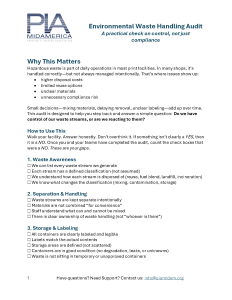
Environmental Waste Stream Audit
Examine how waste is identified, handled, stored and removed—and whether changes in materials, equipment or production have created environmental responsibilities the company may not recognize.
Use this resource to:
- Identify the waste streams produced across the operation
- Consider whether materials are being classified and managed appropriately
- Recognize where documentation or vendor practices may require attention
- Begin a more informed conversation with environmental specialists
Continue with member access:
- Waste Analysis and Environmental Services
- Environmental Compliance Guidance
- FSC Group Certification
Turn Compliance Requirements into Everyday Practice
Compliance becomes meaningful when requirements are understood, responsibilities are clear and the right practices are consistently carried into the work. PIA MidAmerica connects members with print-specific guidance, practical training, experienced specialists and trusted partners who can help companies recognize exposure, interpret what applies and take appropriate action.
Strengthen Workplace Safety
Build a safer operation through relevant guidance, employee learning and an informed examination of the conditions in which work is actually performed.
- OSHA Compliance Guidance — Understand applicable requirements, prepare required programs and records, and respond more confidently to questions, inspections or identified concerns.
- Print-Specific Safety Training — Address the equipment, materials, tasks and hazards employees encounter in print and manufacturing environments.
- Workplace Safety Assessments and Consulting Services — Engage experienced safety professionals to examine workplace conditions, identify areas of exposure and help determine appropriate corrective action.
Manage Broader Business Risk
Recognize where policies, employee practices, regulatory developments and organizational decisions may create exposure beyond the production floor.
- Federated Insurance Risk-Management Resources — Draw on insurance and risk-management expertise related to workplace practices, business continuity, cyber exposure and the protection of the company.
- Regulatory and Advocacy Updates — Follow developments affecting employers and the print industry, with context for understanding what may require attention.
- Traliant Compliance Training — Provide employees and managers with accessible learning addressing harassment prevention, workplace conduct and other employment-related responsibilities.
Address Environmental Responsibility
Understand what the operation generates, how materials must be managed and where specialized environmental or certification expertise can reduce risk and improve practices.
- Clean Earth, now Veolia, Waste Analysis and Environmental Services — Evaluate waste streams, classification, handling and disposal practices with specialists who understand regulated materials.
- Environmental Compliance Guidance — Clarify responsibilities involving waste, documentation, storage, vendors and changes in materials or production processes.
- FSC Group Certification — Access a supported certification pathway for eligible companies seeking to demonstrate responsible sourcing and meet customer requirements.
Put Specialized Expertise Within Reach
Not every compliance question should be answered internally. Regulations can be technical, workplace conditions can be difficult to evaluate objectively and familiar practices may conceal exposure.
PIA MidAmerica’s relationships with safety professionals, environmental specialists, insurers, training providers and industry experts give members informed places to turn before a concern becomes an incident, citation or disruption.
Move from Concern to Accountable Action
Begin with the requirement, condition or business practice that needs greater clarity. PIA MidAmerica connects members with relevant information, practical resources and qualified expertise to help determine what applies, what requires attention and who should be responsible for moving the work forward.
Compliance does not belong to one department or remain confined to a policy manual. It is shaped by employee behavior, operating practices, leadership decisions and the changing requirements affecting the industry. Continue exploring the connected questions that influence how effectively the company recognizes and manages risk.
Identify What Requires Attention
An updated regulatory rule, routine practice, employee situation or unresolved condition create uncertainty about what applies and where the company may be exposed. PIA MidAmerica translates regulatory complexity into the operating realities of print—bringing industry-specific guidance, regulatory perspective and qualified specialists to the question so leaders can determine what requires attention and act responsibly.
Understand the Industry
No company makes decisions in isolation. Changes in markets, technology, customer expectations, workforce conditions, regulation and the economy continually reshape the environment in which print and packaging companies operate.
The challenge is not simply finding more information. Leaders must distinguish meaningful change from ordinary noise, understand how their company compares and determine which external developments may require a different decision inside the business.
That work requires context. A trend gaining attention across the industry may not matter equally to every company. A benchmark may reveal a difference without explaining its cause. A market headline may signal real exposure—or obscure the specific products, customers and operations that will actually be affected.
PIA MidAmerica brings together industry research, performance information, timely updates, peer perspective and supplier expertise to help members understand what is changing, why it matters and where greater attention may be warranted.
- Which industry trends should change how we run the business?
- How does our performance compare with companies like ours?
- Which economic forces are most likely to affect our business next?
Which industry trends should change how we run the business?
The print industry is continually evolving, but not every trend requires the company to change direction. New applications emerge. Technologies become more accessible. Customer expectations shift. Competitors enter adjacent markets. Some developments create meaningful opportunities; others attract attention without offering a strong fit for the company’s capabilities, customers or business model.
When evaluating an industry trend, consider:
- What customer problem or market need is driving the change
- Whether demand is established, emerging or primarily speculative
- Which current customers might value the new capability
- Whether the opportunity builds on strengths the company already possesses
- What equipment, knowledge, workflow or selling capability would be required
- How the economics compare with the company’s existing work
- Which competitors or alternative providers already serve the market
- Whether the opportunity can be tested before a larger commitment is made
- What the company would need to stop, change or prioritize differently to pursue it
A trend becomes strategically relevant when it connects to a genuine customer need and a capability the company can develop, deliver and support profitably. Education is an important first step. Leaders do not need to pursue every emerging application, but they should understand enough to recognize when a development intersects with their customers, capabilities or long-term direction. The goal is not to follow the industry wherever it moves. It is to identify the changes that deserve a thoughtful response from this business.
How does our performance compare with companies like ours?
Company results become more useful when leaders can place them in context. An internal report can show whether performance improved or declined. An industry benchmark can reveal how the result compares with other companies. Peer perspective can help leaders understand the operating choices, market conditions and business models that may be contributing to the difference.
Begin with clarity about the comparison:
- Which performance measure is being examined
- How the company calculates and categorizes the underlying information
- Whether the comparison group resembles the company in size, market, capabilities or business model
- What time period and operating conditions the benchmark represents
- Which differences are significant enough to investigate
- Whether the result reflects one unusual event or a continuing pattern
- What operational, pricing, staffing or customer-mix factors may explain the difference
- Which assumptions should be tested before action is taken
- How the company will measure whether a resulting change improves performance
A benchmark is a reference point, not a verdict. A company can perform differently from the comparison group for sound strategic reasons. It can also appear competitive overall while an important weakness remains hidden inside the average.
The value of comparison lies in the questions it creates. Why is this number different? What are stronger-performing companies doing differently? Does the difference reflect a deliberate choice, an unrecognized problem or an opportunity for improvement? Used responsibly, benchmarking gives leaders a clearer view of the business without substituting someone else’s results for their own judgment.
Which economic forces are most likely to affect our business next?
Economic developments reach a print company through specific customers, materials, costs and decisions. Changes in demand, interest rates, labor availability, energy, transportation, trade policy or material pricing may influence the broader industry. Their effect on an individual company depends on where it buys, what it produces, whom it serves and how quickly it can respond.
When an external development occurs, examine:
- Which customers, products, suppliers or contracts may be affected
- Whether the effect is immediate, emerging or still uncertain
- What information should be confirmed before the company responds
- Whether exposure varies by material, classification, source or application
- How changes may affect total job cost, margin, production or delivery
- Which alternatives are available and what tradeoffs they introduce
- What purchasing, pricing or inventory decisions may need to change
- When customers should be informed or asked to approve an alternative
- Which supplier, regulatory or industry expertise can provide additional context
- What assumptions should be monitored as conditions develop
Broad headlines rarely describe the company’s full exposure. Acting too quickly can create unnecessary disruption, while waiting for complete certainty can leave the business unprepared. A disciplined response separates what is known from what remains uncertain. It verifies the company’s actual exposure, evaluates available options and prepares the conversations that may be required. Leaders cannot predict every external development. They can build a more reliable way to interpret change and decide what the business should do next.

Canadian Paper Tariffs: What Printers Can Verify Now
Understand your company’s numbers, recognize meaningful comparison points, and use the difference to inform better pricing, staffing, and investment decisions.
Use this resource to:
- Understand why tariff exposure must be evaluated product by product
- Identify the grades, classifications and supplier information that require confirmation
- Evaluate alternatives across performance, total cost, production and delivery
- Prepare more informed conversations with customers before recommending a change
Continue with member access:
- Regulatory and Trade Updates
- Paper Market and Supply-Chain Intelligence
- Supplier and Industry Connections

Compared to What - And Then What?
Explore how less-visible risks can develop through routine decisions involving employees, policies, access, contracts and business practices—and why identifying exposure early gives leaders more options.
Use this resource to:
- Examine the company numbers and operating assumptions behind the comparison
- Understand what a benchmark measures—and what it cannot reliably tell you
- Turn performance differences into focused management questions
- Combine reports, modeling and peer perspective before deciding what should change
Continue with member access:
- Performance Indicator Reports
- Wage + Benefits Survey and Reports
- Peer and Market Trend Conversations

Beyond Fabric: Where Dye-Sublimation Expands What's Possible
Dye-sublimation is expanding beyond fabric banners and apparel into retail environments, interior décor, promotional products and other applications. Explore what is driving this growth—and what printers should understand about substrates, production, customer demand and market fit before pursuing the opportunity.
Use this resource to:
- Recognize applications for dye-sublimation beyond traditional soft signage and apparel
- Understand how different substrates and production methods expand what can be produced
- Consider the shipping, sustainability and production advantages influencing market growth
- Identify customer needs and adjacent markets worth exploring before investing
Continue with member access:
- Beyond the Page
- MidAmerica U Wide-Format Learning
- Wide Format Peer Group
Turn Industry Information into Business Understanding
Industry intelligence becomes valuable when leaders can connect external developments and comparison points to the decisions their company must make. PIA MidAmerica gives members access to timely information, print-specific learning, performance resources, peer perspective and industry relationships that help bring greater context to change.
Explore Markets and Emerging Opportunities
Understand how new applications and evolving customer needs may create opportunities beyond the company’s current work.
- Beyond the Page — Explore applications, markets and forms of print that extend beyond traditional commercial production.
- MidAmerica U Wide-Format Learning — Build practical knowledge about wide-format technologies, applications, production considerations and market development.
- Wide Format Peer Group — Learn from industry peers who are navigating similar questions involving equipment, workflow, customers and growth.
Interpret Market and Economic Change
Move beyond broad headlines to understand how external developments may affect materials, customers, costs and business decisions.
- Regulatory and Trade Updates — Follow policy and trade developments with context for understanding their potential relevance to print businesses.
- Paper Market and Supply-Chain Intelligence — Monitor changes involving paper, sourcing, availability and other conditions that may influence production and purchasing.
- Supplier and Industry Connections — Reach companies and specialists with direct knowledge of materials, equipment, markets and changing industry conditions.
Put Company Performance in Context
Use credible comparison points and experienced perspective to ask better questions about financial, operational and workforce performance.
- Performance Indicator Reports — Compare company results with industry performance information and identify areas that warrant closer examination.
- Wage + Benefits Survey and Reports — Understand compensation and benefit practices across relevant positions, markets and company groups.
- Peer and Market Trend Conversations — Add operating experience and industry perspective to the numbers before determining what should change.
See More than One Source Can Reveal
No single report, survey, supplier or peer can provide a complete view of the industry. PIA MidAmerica brings different forms of intelligence together. Research can identify a pattern. Performance information can establish a comparison point. Peers can explain how conditions are playing out inside other companies. Suppliers and specialists can clarify what they are seeing across technologies, materials and markets. Together, those perspectives help members test assumptions, recognize meaningful change and make decisions with a broader view of the industry.
Move from Information to Business Relevance
Begin with the trend, comparison or external development the company needs to understand. PIA MidAmerica connects members with credible information and experienced perspectives to help determine what is changing, how it may affect the business and where deeper investigation or action is justified.
Understanding the industry creates value when external insight leads to stronger decisions about the company’s direction, operation, investments and relationships. Continue exploring the connected questions that help turn industry knowledge into business action.
Understand What Deserves Attention
A new application, performance comparison or external development can demand attention before its business meaning is clear. PIA MidAmerica interprets the signal through the realities of print—combining industry intelligence, peer experience and specialized expertise to reveal where the company may be exposed, where opportunity may be emerging and what deserves action.